If you’ve never taken the time to read what’s on your soap, you might want to make an exception for Dr. Bronner’s Magic Soaps, an old hippie favorite. Thankfully, the Dr. Bronner Company has put at least some of its text-packed soap labels online, so I don’t have to copy all of the information contained on my “18-in-1 Hemp ALMOND PURE-CASTILE SOAP” bottle – you can read the pdf here. Further labels here. The bottle I have in front of me actually has a different inscription from the online one, so the company seems to update their labels from time to time to include new/rotate old content.
Dr. Emanuel Bronner, who penned these strange and endearing soap wisdoms, was a German jew who escaped to the US in 1929 (dropping the “Heil” from his original name “Heilbronner”).
 My Bookshelf
- An error has occurred; the feed is probably down. Try again later.
Next To Godliness
18. February 2011 — cohuStranger In A Strange Land
10. February 2011 — cohuA German restaurant just opened in Berkeley and I thought I should have a look at the relevant Chowhound thread before venturing there myself. It sounds authentic indeed:
“There was no hostess so people did not know how to get a table and were left loitering near the door (none of the servers bothered to pay any attention to the number of people standing around waiting for a table. Bizarre).” (breanac on Chowhound)
Oh my, poor Americans, standing there like third-graders whose mom forgot to pick them up from soccer practice…welcome to the third world, where people just sit down! This is how we roll in pre-civilization Europe. You’re on your own. People fighting over chairs and tables. Tushies lowered onto seats without a hint of official authorization. Couples hogging four-seat tables. In short, anarchy. Adjust your tip accordingly! Overall, the restaurant sounds OK enough to check out, even though it threatens to deliver “Cooking and Baking with a North-German Twist“.
(This comment makes me doubt the overall qualification of the contributors to this forum, though. I will not take this kind of abuse from the inhabitant of a country where “fresh joe” is routinely served from something fittingly named a “coffee urn” sitting on the counter, filled with a fluid so obnoxious that “refill” sounds like a death threat to anyone with taste buds or even just an innervated tongue.)
Strange Fruit
7. February 2011 — cohuDo you squeal with glee when you discover the bell pepper you’re slicing contains an internal “baby” pepper (maybe even one of a different color?), or when you come upon a mushroom that looks like someone’s backside, or a carrot that looks like a little man? In that case, you’ll love Uli Westphal’s Mutato Collection. (You might also like Bhudda’s Hand citron – I saw them on sale in the grocery store last week but was to scared to actually buy one!)
Let Them Eat Arugula
2. February 2011 — cohuA few days ago, Mark Bittman was known for his brilliant, accessible recipes and his adorably crappy kitchen. Now, he’s suddenly turned into (yet another) full-time “food activist” who churns out legislative suggestions under the heading “A Food Manifesto For The Future”. While some of his ideas, e.g. reduction of corn/soy subsidies, seem reasonable, most of them are unsubstantiated, misleading, and questionable.
Like many of the modern priests of foodie-ism, he rails agains “processed” food. I do not know what that means, and I think he doesn’t, either. If the metric is supposed to be that a lot of technology is necessary to make “processed” food – and if there’s actual scientific proof that this is a Bad Thing -, then, by all means, let’s throw out the Cheetos. Let’s also throw out cheese, beer, wine and bread, which do not grow on trees (Have you tried making cheese lately? It involves chemistry. If you don’t do it right, you end up with a highly toxic end product). And while we’re at it, let’s throw out all modern plant varieties that were genetically engineered over centuries to suit our needs. There were, for example, no big juicy red apples in paradise, contrary to what some faulty illustrations of the scripture would like you to believe – only malus sieversii, whose taste Michael Pollan, another Born-Again Foodie Priest, describes thusly: “imagine sinking your teeth into a tart potato, or a mushy Brazil nut sheathed in leather (“spitters” is the pomological term of art here), and then tasting one that starts out with high promise on the tongue—now here’s an apple!—only to veer off into a bitterness so profound that it makes the stomach rise even in recollection.” Lots of technology and “processing” was needed to turn the inedible crap Mother Nature usually serves us into Braeburns and Fujis. Whether food is “heavily processed” or not is a red herring. The quest for “natural” food seems to simplify food choices – in reality, it makes them simpler than they are.
The opposite of “processed”, in Bittman’s terms, is “real” or “actual” food. His categories of “processed” and “real” seem to be metaphysical rather than based on physical reality (much like “kosher” and “treif” or “halal” and “haraam”) – only this time, there’s no God upstairs who hands out these food rules and tells us to obey them for his sake. There’s only food itself. “Real” food takes the place of a the spiritual cure, the saviour. I like food as much as the next person, but I find this icky.
On a less philosophical note, Bittman analyzes the failing of government agencies over the last decades and attributes a big chunk of the American problem with food to misguided nutrition advice. Not really a new idea. The only surprising thing is his solution to the problem: More power to (other) government agencies, more nutrition advice and reeducation – let’s just get it right this time.
And that, for him, means advocating for a largely vegetarian diet, because: “It’s difficult to find a principled nutrition and health expert who doesn’t believe that a largely plant-based diet is the way to promote health (…)” – While this may be true, it is also true that fifty years ago it would have been “difficult” to find a “principled [probably means “mainstream”?] nutrition and health expert” who didn’t believe that a vegetarian diet is unhealthy. The data on the long-term, large scale effects of diet is extremely sketchy. This has not changed over the last 50 years, simply because a behavior as complex as human nutrition is extremely difficult to observe, even more so if we want to apply the usual principles of empirical science. If you don’t believe this, just go ahead and try doing a double-blind randomized longitudinal study of a “plant based diet” in humans (I’m waiting!). Even more sketchy (or non-existent) is the data on effects of large-scale nutritional intervention, like the reeducation programs, subsidies, “truth in labeling” and “legislation curbing relentless marketing” Bittman suggests. They might help. They might cause harm, because they might not have the intended effect, or if the intended effect turns out to be unhealthy after all. Finally, they might cost a lot of taxpayer money and do nothing at all. And this would be bad, because poor nutrition, I believe, is not a result of moral turpitude, stupidity or (to use more friendly, modern reformulations of the same principle) misguided advice and ignorance, but largely caused by a lack of money in the individual. The effects of this lack of money – a.k.a. poverty – are, by and large, not mitigated by reeducation or telling people to behave differently, but by giving people money or at least not taking it from them to print posters which tell them to feed their kids more broccoli.
Lastly, I have always envied Bittman for his way with words, and for his talent to write short, simple recipes that are surprising, educational and mouthwatering at the same time. His food writing does not need pretty pictures – it speaks for itself. His political writing, on the other hand, is abysmal: “Reinvest in research geared toward leading a global movement in sustainable agriculture, combining technology and tradition to create a new and meaningful Green Revolution.” Man, I wish he would step down from his pulpit and write about food again.
Early spring, or not
2. February 2011 — cohuPunxsutawney Phil, the world’s most famous Marmota monax, has just predicted an early spring for this year:
But the Guardian’s empirical analyis reveals that, shockingly, groundhogs “do not have a good track record for accurate weather prediction”. (Why is it so often Englishmen who make it their job to battle the irrational beliefs of Americans?)
It’s a good sign
22. January 2011 — cohuBerkeley is full of people who have strong opinions, and thus, full of various types of signs. First off, if your car does not have an Obama sticker, it is understood that you’re either a) sceptical of Obama because he’s so moderate he’s basically a crypto-fascist or b) somewhat of a crypto-fascist yourself. (Exception: If you drive a Prius or a Subaru, you’re not required to use any additional stickers, it’s already clear you’re a Lib’rul or worse.) Further stickers that are beloved by Berkeleyans: the COEXIST, the KPFA, and the Darwin Fish. If you have collected lots of political opinions over the decades, your car will slowly turn into this – a common sight on Berkeley parking lots. (Up in the hills, one bumper is still telling us to “END APARTHEID NOW”). There’s lots of lawn signs, murals, and signs in windows. Signs on bikes declaring “NO WAR FOR OIL – BIKE FOR PEACE”.
And then, there’s the “YOU’RE PERFECT” guy:
(Note the North Face fleece vest – the Berkeley uniform!)
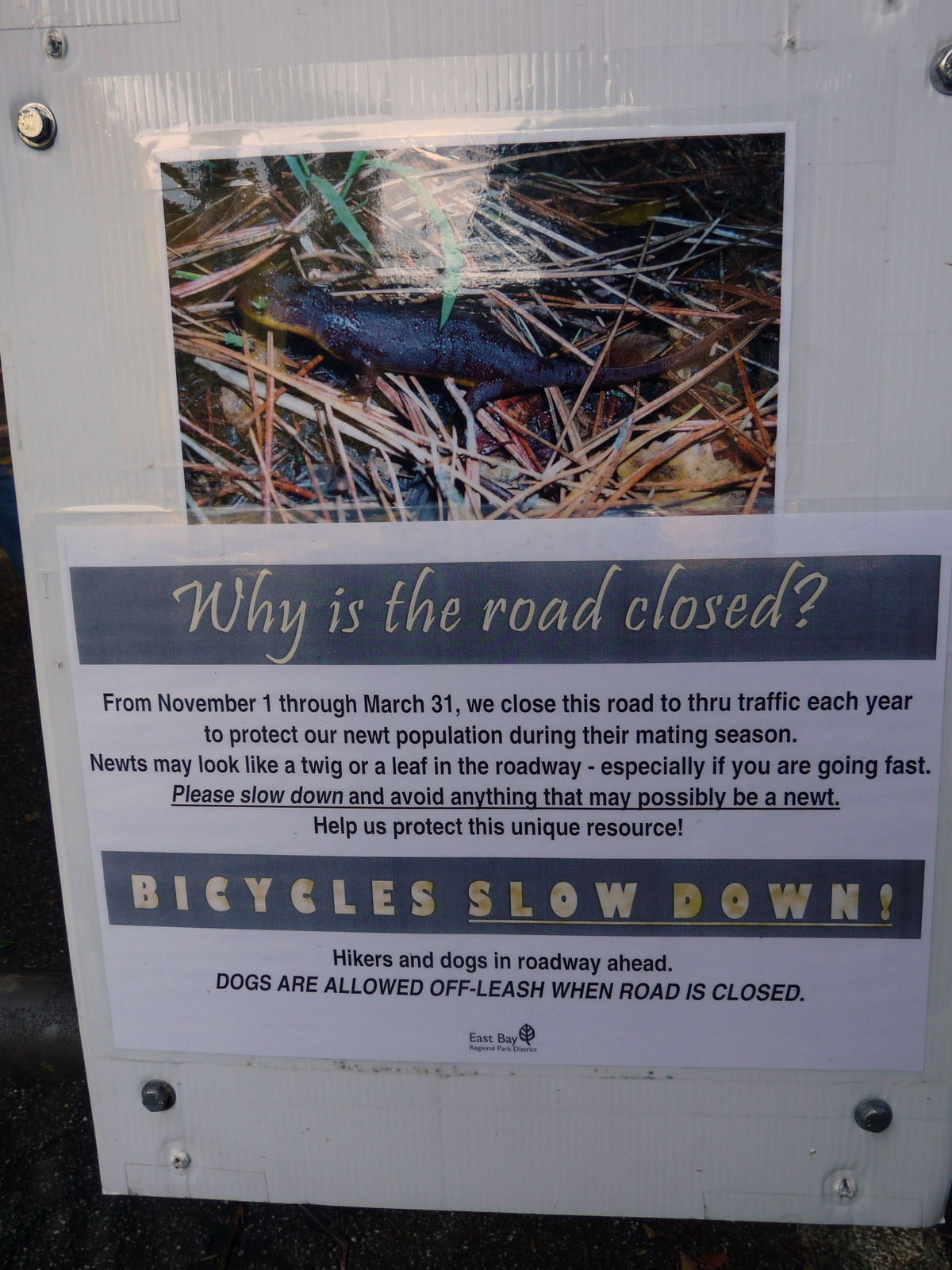
Some see this annoying abundance of signage as a signal to fight back. My favorite meta-stickers adorn our neighbor’s Honda: “BRUSH YOUR TEETH, IT’S THE LAW” and “Vote YES on NO and NO on YES”. The most incendiary and controversial sign in Berkeley at the moment, however, must be this:




So that’s why all my horoscopes were wrong!
13. January 2011 — cohu“The ancient Babylonians based zodiac signs on the constellation the sun was “in” on the day a person was born. During the ensuing millenniums, the moon’s gravitational pull has made the Earth “wobble” around its axis, creating about a one-month bump in the stars’ alignment.” (Minneapolis Star Tribune)
And thus, according to Parke Kunkle of the Minnesota Planetarium Society, your astronomically “correct” zodiac sign might be different from what astrologers usually tell you. These are the new zodiac dates, corrected for the stars’ actual current alignment:
Capricorn: Jan. 20-Feb. 16. Aquarius: Feb. 16-March 11. Pisces: March 11-April 18. Aries: April 18-May 13. Taurus: May 13-June 21. Gemini: June 21-July 20. Cancer: July 20-Aug. 10. Leo: Aug. 10-Sept. 16. Virgo: Sept. 16-Oct. 30. Libra: Oct. 30-Nov. 23. Scorpio: Nov. 23-29. Ophiuchus: Nov. 29-Dec. 17. Sagittarius: Dec. 17-Jan. 20.
I’m a Libra now instead of a Scorpio! So next time someone takes offense with my habitually grating personality, I will tell them to shut up because there’s SCIENTIFIC PROOF for the FACT that I am of extremely agreeable, diplomatic and charming character.
Pinocchio
13. January 2011 — cohu
Look at this huge pinecone we found on a recent trip to Mt. Diablo! I’m so glad we have a SUV because we couldn’t have brought it home in a compact. In addition to football-sized dimensions and considerable weight, the cone also has hooked spurs that were still pointing outwards when I plucked it from the tree – it looks much less threatening now that it’s opened up. Thanks to the helpful and adorably Comic-Sans-ish page Pining for Pines by J. Zimmerman, Ph.D., I’ve identified it as a Big-cone Pine (well, duh!) or Pinus coulteri. Wikipedia happens to have a fitting name for it as well:
The large size of the cones has earned them the nickname “widowmakers” among locals. (Wikipedia: Coulter Pine)
This is not really an exaggeration because they can weigh up to 10 pounds – which makes them the heaviest pinecones in the world. (The world’s largest tree Sequoiadendron giganteum has disappointingly tiny cones, by the way.)
Music: meh.
11. January 2011 — cohuThe BBC lets you assess your musicality in a quite extensive test (Registration required). It was fun but my results are a bit strange:
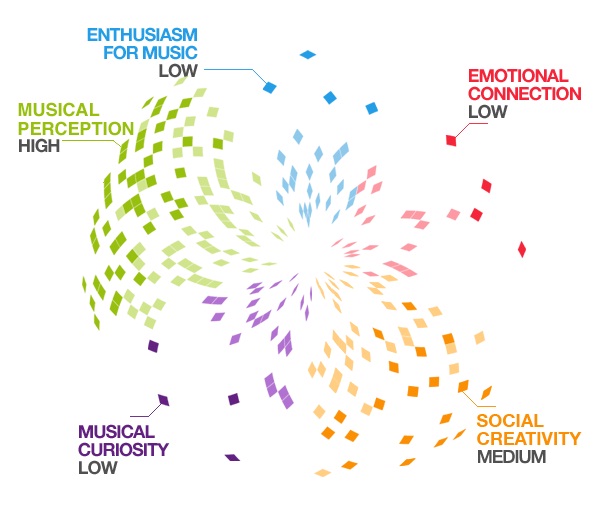
I got 98% in “Musical Perception” even though I got all of the genre matching snippets wrong. I mean, literally all of them. 15 out of 18 in the “match the beat” section and moderate results in the “tap the beat” test. 12/12 in melody memory was enough to still arrive at 98% overall…so I guess everybody who’s not deaf is a Beethoven for the BBC. Very nice of them.
Now for the bad part of the test: my “emotional connection”, “enthusiasm” and “curiosity” scores are dismal – 1%, 1% and 2%, respectively. Doesn’t that sound terrible? I have to admit it’s true, I just don’t like music that much. I love my Christmas present though.
(I wonder whether there are people who get the reverse – 1% in perception, 99% in enthusiasm. They are probably very lonely. UPDATE: I think I found one!)
 cohu's blog